The Technology Pillar
Most companies don't have an AI stack. They have AI features bolted onto yesterday's processes.

The Technology Pillar
Everyone is talking about AI. Copilots, agents, autonomous workflows. But when we sit down with the founders, CTOs and ops leaders actually running fast-scaling companies, the reality looks nothing like the LinkedIn posts.
People in over 90 percent of companies are using AI tools at work today. The trouble is that almost none of those companies can answer the only question that actually matters: where exactly is my business today, and what's the next move?
That's the job of the Dragonfly AI Readiness Framework. It evaluates a business not by how many tools it owns, but by how much human effort is still required to move work from one step to the next inside its core processes. Across that mapping work, in sales, support, engineering, HR, finance and marketing, one pattern repeats: most scaling companies are stuck somewhere between digitised and automated, nowhere near ready to unlock what AI can actually do for them.
Download the full PDF resource
Enter your email address below to unlock the downloadable PDF version of this resource.
Thank you! Click below to download your PDF.
Download PDFThree pillars, one honest diagnostic
The framework looks at readiness through three pillars.
Technology asks whether the tools at each stage of your core processes are actually doing the work, or whether your team is silently filling the gaps between them with copy-paste, side spreadsheets and end-of-day catch-ups.
People is about what happens after the tools are in. If you've shipped AI to your team and watched most of them drift back to their old workflows within weeks, the People pillar explains why that isn't an adoption problem at all, and what has to shift underneath for any of the tools to actually stick.
Strategy is what holds the other two together. If your AI strategy was greeted with applause at the offsite but you can't name a single thing it has changed in the business since, the Strategy pillar lays out the decisions any real strategy has to commit to, the ones most leadership teams quietly skip.
Most companies don't have an AI stack. They have AI features bolted onto yesterday's processes.
Inside the Technology paper, a first look
This summary covers paper one of three, the Technology pillar. It comes first for a reason. People won't adopt tools that don't fit how their work actually flows, and no strategy can compensate for a stack that's quietly held together by human effort. Before you can change the work, you have to see it clearly. That's what the Technology pillar is for.
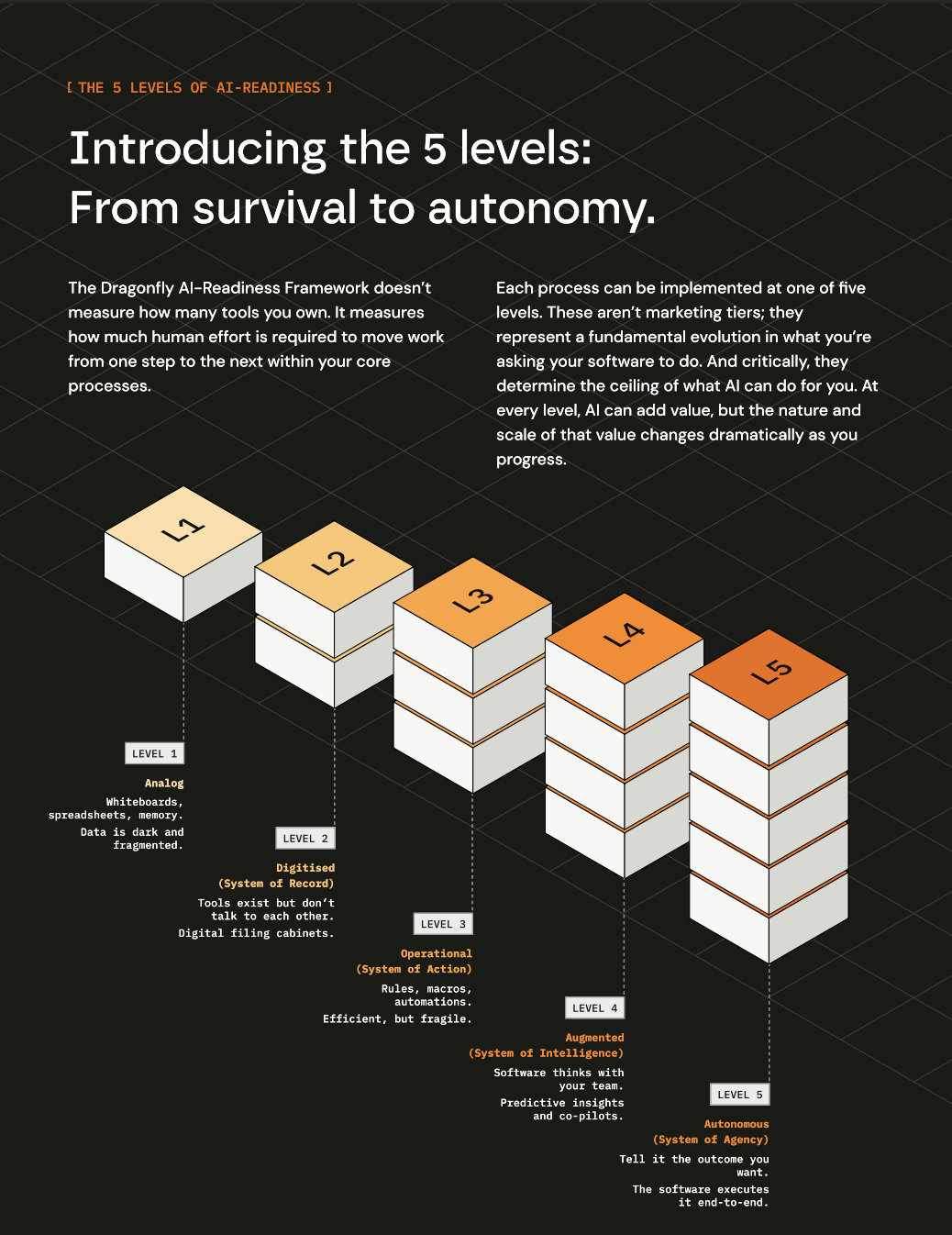
Within Technology, every core process in your business sits at one of five readiness levels. These aren't marketing tiers. They represent a fundamental evolution in what you're asking your software to do, and they determine the ceiling of what AI can deliver for you.
- Level 1, Analog. Whiteboards, spreadsheets, and people remembering things in their heads.
- Level 2, Digitised. Systems of record. CRMs, ERPs and helpdesks that store information but don't move it.
- Level 3, Operational. Rules and macros stitching tools together. Efficient, but fragile.
- Level 4, Augmented. Software that thinks with your team. Predictive insights, copilots, context-aware workflows.
- Level 5, Autonomous. Software that runs end to end. You set the outcome, the system does the work, and only loops in humans when judgement is actually required.
AI adds value at every level. But the magnitude compounds as you climb. A company stuck at Level 2 is leaving most of AI's potential on the table, not because they lack ambition, but because their infrastructure can't support it.
The trap: everyone thinks they're at Level 4
Almost every leadership team we sit with believes they're already operating at an advanced level. They have a CRM. They have dashboards. They've rolled out a copilot, maybe experimented with agents. So they assume they're AI-ready.
But when we map the real flow of work, the picture changes fast. Data is still being copied between systems by hand. Decisions still live in people's heads. Automation exists, but it's brittle. A patchwork of if/then rules duct-taped across tools that were never designed to work together.
That's Level 2 and Level 3 behaviour wearing a Level 4 badge. It's also exactly where most AI projects quietly fail.
AI doesn't fix broken processes. It exposes them.
Layering intelligence on top of fragmentation doesn't transform anything. It just makes the cracks faster and more visible. The real work isn't choosing better AI. It's seeing your processes clearly enough to know which ones can actually carry intelligence, which ones need to be redesigned first, and which ones are being held together by nothing but human patience.
That diagnostic, applied to your business, is what the rest of the Technology paper delivers.
What's in the full paper
What you've just read is the framework in outline. It's the part that fits in a website summary. The paper itself is where the framework becomes a tool you can actually use, and that's the part that changes how you spend the next twelve months. The summary makes the case. The paper makes the difference. Inside, you'll find:
- The full anatomy of each of the five levels: what AI can and can't realistically do at each, why the ROI equation flips between Level 3 and Level 4, and where most companies actually sit, which is rarely where they think they sit.
- The decision framework for when Level 5 is the right call and when chasing it is a mistake. Moving every process to autonomy isn't the goal, and treating it as one is as misguided as buying tools without a strategy.
- Worked examples for outbound sales and customer support, mapping the exact stages, tools and metrics that shift as you climb the framework.
- How Dragonfly's AI Readiness Platform turns the framework into a live benchmark of your specific stack against the best alternatives in the market, so you stop guessing and start comparing.
If you stop reading at the summary, you'll have a sharper way of talking about AI readiness. If you read the paper, you'll have a sharper way of running the business.
The next generation of companies won't win by owning more software. They'll win by evolving faster than their market, and that journey starts with brutal clarity about how your business actually runs today.
Download the full paper to see where yours stands.
AI doesn't fix broken processes. It exposes them.