Stop buying AI tools. Start building an AI-Ready company.
This is Part 1 of our three-part series on AI Readiness. Part 2 dives into 'The Five Levels of AI Readiness', followed by part 3 which explores How Dragonfly Benchmarks Your Stack Against 250,000 Vendors.

.png)
Everyone is talking about AI. Copilots. Agents. Autonomous workflows. But when we sit down with companies, Founders, CTOs, Ops Leaders; the reality looks nothing like the LinkedIn posts we read every day.
Most aren't blocked by a lack of tools. They're blocked by the way their business is built.
At Dragonfly, we've spent the last year mapping thousands of tech stacks across sales, support, engineering, HR, finance and marketing. What we've learned is blunt:
You don't become AI-ready by buying AI tools. You become AI-ready by changing how work flows through your company.
AI Readiness Is a Stance, Not a Purchase
Put differently: AI readiness is a stance, not a purchase. What is your organisation's posture towards this shift? What have you actually put in place, or changed, to enable this transition? If the answer is "we bought some new tools but nothing else is fundamentally different," you have the wrong stance. The tools will underperform, the investment will stall, and six months from now you'll be wondering why the AI revolution passed you by.
That's why we built the Dragonfly AI Readiness Framework; a new way to measure where your business actually is today, and what it will really take to move forward. The framework evaluates readiness across three pillars:
Technology — are you using the right tools for each stage of your core processes, or are you running yesterday's stack and expecting tomorrow's results?
Strategy — do you have clear direction on what AI should be doing for your business? Do you have policies for data use, risk mitigation, and fair use or are your teams experimenting in the dark?
People — are your teams equipped to work alongside AI? Are you building literacy, sharing knowledge, and creating a culture that actually adopts what you're investing in?
Today we're launching the first pillar of that framework: a technology benchmark that scores your tooling stack against the best in the market, department by department.
AI doesn't fix broken processes. It exposes them. Every company we work with discovers the same thing: the moment you introduce intelligence into a workflow that was never designed for it, the cracks don't close. They widen. That's not a failure of AI. That's AI doing exactly what it should, showing you where the real work needs to happen.
Your Software Is Not a Set of Tools. It's How Your Business Runs.
Before we get into the framework, we need to reframe how you think about your tech stack.
Across every team in every company, the same basic pattern exists. A customer is found. A task is created. Someone takes action. A result is delivered.
We call that pattern a process, the fundamental sequence of steps required to turn intent into outcome. Your software stack is simply how you choose to implement that process.
This distinction matters because most companies treat software as utility, a tool you buy to do a job. But software isn't a utility. It's the implementation of a process. And if you don't understand the process underneath, you can't evaluate whether the tools on top are helping or hiding the problem.
You don't become AI-ready by dropping AI into this flow. You become AI-ready by understanding how these processes really operate today, where humans are compensating for broken systems, where data gets lost, and where automation is pretending to be intelligent.
If you bought a copilot but your teams are still copying data between spreadsheets by hand, you don't have an AI strategy. You have a subscription.
The Problem Nobody Wants to Admit
Almost every leadership team we speak to believes they're already operating at an advanced level. They have a CRM. They have dashboards. They've rolled out a copilot, maybe experimented with agents.
So they assume they're "AI ready."
But when we map their real workflows, the picture changes fast. Data is still being copied between systems by hand. Decisions still live in people's heads. Automation exists, but it's brittle, a patchwork of if/then rules duct-taped across tools that were never designed to work together.
You can't layer intelligence on top of fragmentation and expect transformation. You just end up with chaos, a lot more noise and more surface-level automation masking deeper structural problems.
AI doesn't fix broken processes. It exposes them.
The first step is understanding where you actually stand. Not in terms of how many tools you own, but in terms of what your software is really doing for you, and what it could be doing if your processes were built to support it.
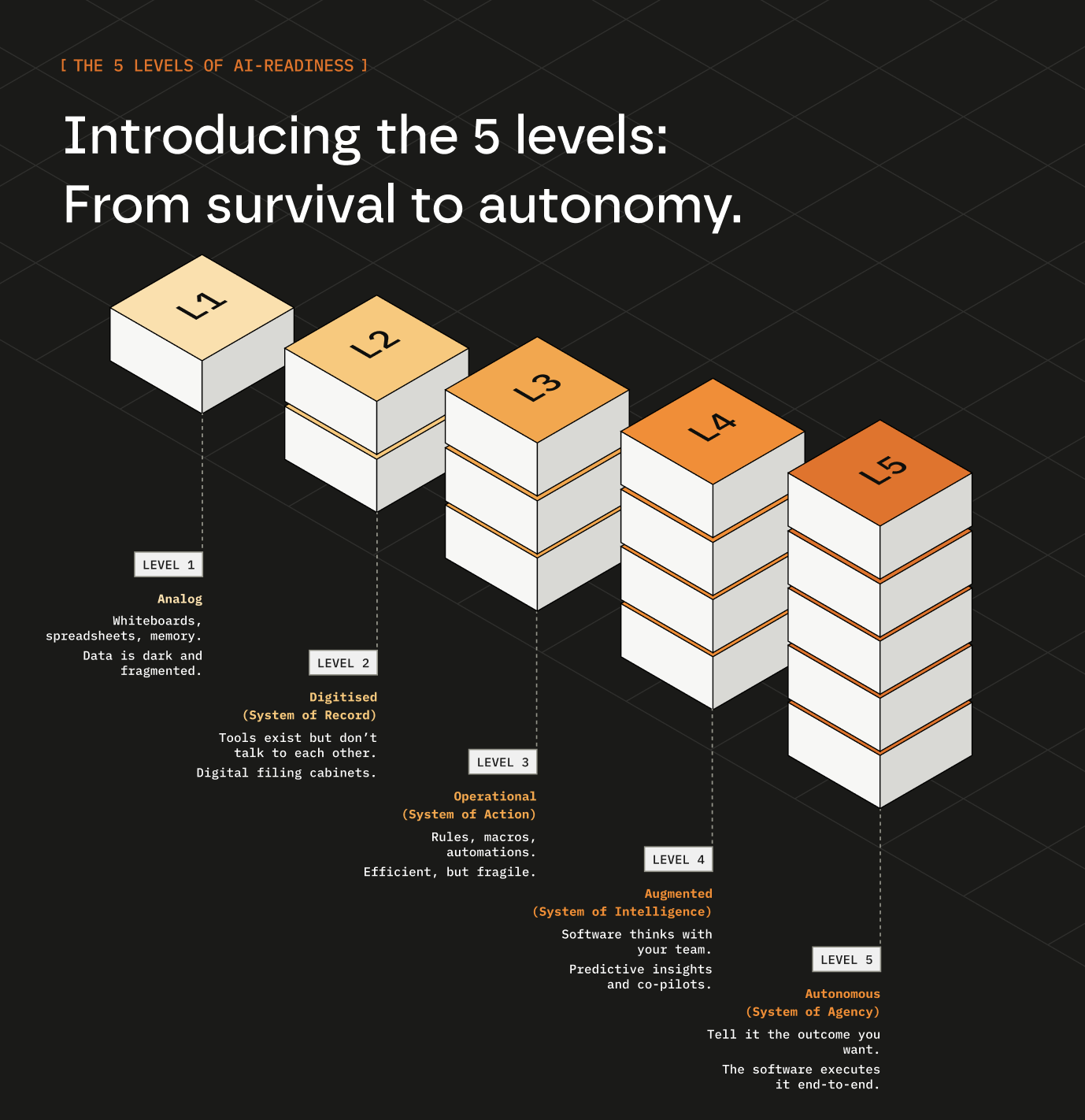
In Part 2 of this series, we break down [The Five Levels of AI Readiness], what AI can actually do for you at each level, and why most companies are two levels lower than they think. We also walk through real examples in Outbound Sales and Customer Support to show what each level looks like in practice.
Download the full PDF resource
Enter your email address below to unlock the downloadable PDF version of this resource.
Thank you! Click below to download your PDF.
Download PDF