Resources to help you build, manage, and evolve your architecture
Dive into playbooks, reports, and insights that help teams cut through vendor bias and build a smarter tech stack that's ready for what's next.
Filter by
Showing
0
of
0
items
News
September 2, 2026
0
min read
Modern Data Stack joins Dragonfly.
And it's just getting started
Sean King & Sven Sabas
Dragonfly Founders
September 2, 2026
0
min read
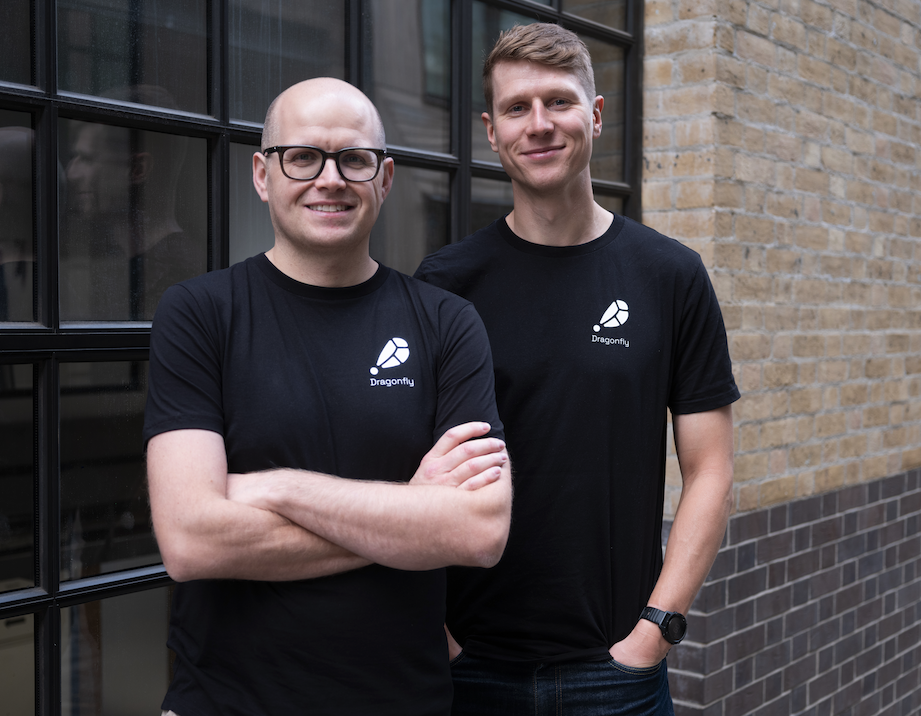
Sean King & Sven Sabas
Dragonfly Founders
Some communities define an era.
Modern Data Stack is one of them: the place where the data world goes to understand its tools, see how real companies build their stacks, and hear from the people doing the work. Today we're announcing that Modern Data Stack has joined Dragonfly, and with it, the best map anyone made of the data tooling era becomes part of the intelligence layer we're building for the AI era.
And if you've just landed here after reading our acquisition announcement: welcome, this is exactly where you're meant to be. What you loved about Modern Data Stack isn't going anywhere. It's about to get a much bigger engine behind it.
So, what happens to Modern Data Stack?
Here's the plan, and we think you're going to like it.
First: the scope grows, because your work already did. The people who spent the last decade assembling data stacks are now the ones being asked about AI tools, agents, integrations, security and spend, and the interesting questions stopped ending at the data layer a while ago. So Modern Data Stack now covers the whole technology stack, with the same practitioner honesty it brought to data tooling, and with Dragonfly's knowledge graph of more than 300,000 software vendors powering it.
Second: here's a taste of what's coming. Articles that give you a clear read on where the tooling market is moving, from new categories forming to quiet consolidation. Interviews with practitioners making real tooling decisions, on what's working for them and what isn't. Research into what businesses are really asking about their stacks right now, and what that reveals about where teams are stuck. Podcasts and explainers on what a tool category actually does, before a vendor gets the chance to explain it to you. And underneath all of it, the directory this community spent years building, now feeding our knowledge graph and doing what it was always for: helping people choose technology well.
And that's only what we can talk about today. There's more in the works than we're ready to show, and when we are, this community will hear it first.
Why we did this
The movement Modern Data Stack chronicled didn't fade; it quietly won. The modern data stack became simply how companies work with data. And that win proved something: when one part of the stack gets mapped, benchmarked and chosen deliberately, with honest information, everything built on top of it transforms.
That idea, applied to every part of the stack rather than just data, is Dragonfly. An AI-powered intelligence layer that understands how a business operates on the inside, tracks how the technology market moves on the outside, and turns the two into decisions and the automated work that follows. Modern Data Stack proved the idea for one layer. We're building it for all of them.
And the values line up just as well as the maps do. Our knowledge graph has no paid placements and never will, because we believe technology decisions belong to the businesses that live with the consequences, not the vendors selling them. Modern Data Stack held that same line for years before we ever spoke. Bringing this community into a company built on its convictions wasn't a hard decision.
To the Modern Data Stack community: thank you for what you built. The best of it is ahead, and we'd love you along for it. Follow the Modern Data Stack page and subscribe to the newsletter above so the next chapter lands in your inbox.
And if you're curious what Dragonfly can already tell you about your own stack, come take a look.
The full press release is here.
Awards
August 26, 2026
0
min read
From 1,600 Startups to the Onstage Stage
This summer gave us one of those moments where you suddenly realise just how far you’ve come.
Sean King
CoFounder
August 26, 2026
0
min read
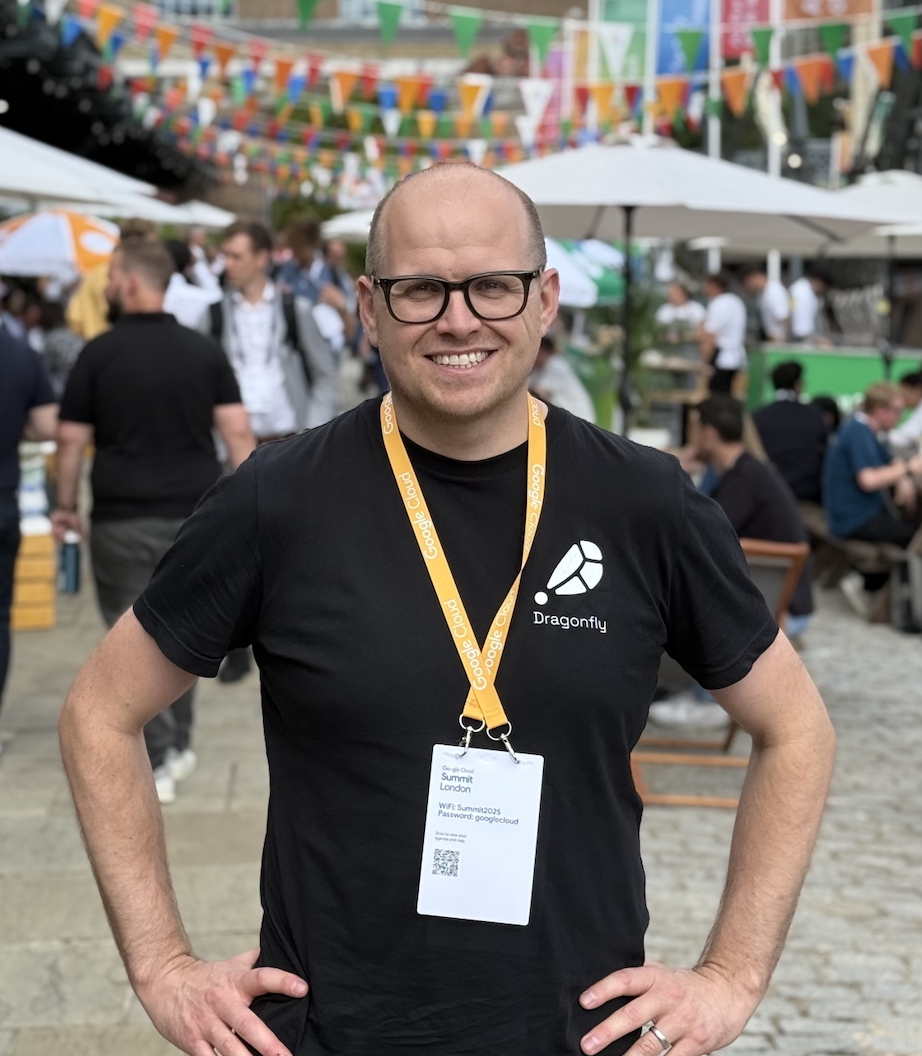
Sean King
CoFounder
From 1,600 applications to the final cohort
This summer gave us one of those moments where you suddenly realise just how far you’ve come.
More than 1,600 startups from across Europe applied to be part of Onstage S26.
When we applied, we were optimistic. Dragonfly was only around 18 months into its journey, but we were already seeing fantastic interest in what we were building. Making the Top 100 alone would have felt like a pretty significant milestone for us. Then we found out we were going further.
Dragonfly had been selected as part of the final cohort invited to pitch live in London, in front of more than 100 VCs and senior leaders from across the European startup ecosystem, with the event streamed live for anyone around the world to watch.
Suddenly, it all felt very real.
And we had just 60 seconds to explain why Dragonfly should exist.
The appetite of enterprise has changed
I started the pitch with something we see every day:
The appetite of enterprise has changed.
Large organisations are adopting new software, AI and new capabilities faster than ever before. At exactly the same time, the number of products, vendors and possibilities available to them has exploded.
So I asked the room a question...
How many of you have looked to adopt a new piece of software in the last 12 months?
A lot of hands went up.
Then I asked them to keep their hands up if they had found that process even slightly overwhelming.
Plenty stayed up.
There is no simple or scientific way for most businesses to know whether they have really assessed the market, understood all the options available to them, or made the right decision.
And that is exactly the problem Dragonfly is being built to solve.
Building the platform of intelligence
Businesses want to adopt AI. They want to modernise the way they operate. They want to take advantage of new capabilities as they emerge.
But understanding what they already have, what is actually being used, what is changing in the market and what they should adopt next is becoming almost impossible to do manually.
There is simply too much happening.
Dragonfly is the platform for that change.
We help organisations understand where they are today: what tools they have in place, what people are actually using, how much they are spending, where AI is already being adopted and where opportunities are being missed.
We then connect that internal picture with our knowledge of the outside world.
We look across the software market: the vendors, emerging products, new capabilities, security considerations and the trends shaping how modern organisations work.
By bringing those two worlds together, we can give businesses highly targeted recommendations about what they should do next.
Not another generic list of software.
Not another static assessment.
Recommendations built around the reality of that particular organisation.
Ultimately, we’re here to help businesses adopt modern tooling and take their organisations from where they are today to where they can be tomorrow.
“Dragonfly helps businesses understand where they are today, so they can make better decisions about where they go tomorrow.”
A milestone for Dragonfly and a new chapter for Onstage
That was the story we had 60 seconds to tell on the Onstage stage.
And while standing in front of a room full of investors was exciting, the bigger thing for us was seeing just how strongly the problem resonated.
We are still incredibly early in the Dragonfly journey. But moments like this give us even more confidence in the direction we are heading.
And it turns out it was a pretty significant summer for Onstage too.
Since our Demo Day, Onstage has joined Sifted, bringing together a platform built to discover and champion some of Europe’s most exciting early-stage companies with one of the defining voices covering European technology and startups.
It feels like a natural next chapter for Onstage, and we’re incredibly proud that Dragonfly got to be part of its story at such an exciting moment.
For us, being part of the Winning Onstage S26 cohort was a fantastic milestone.
But it also felt like exactly that: a milestone, not the destination.
We’re only just getting started.
News
August 17, 2026
0
min read
Ten 'secure' tools can still make one insecure stack. Dragonfly and UCL just won Innovate UK funding to fix that.
18 months, $1m, and one goal: turning the UK's Software Security Code of Practice into something businesses can actually use
Sean King & Sven Sabas
Dragonfly Founders
August 17, 2026
0
min read
Sean King & Sven Sabas
Dragonfly Founders
Ten "secure" tools can still make one insecure stack. We've just been backed to fix that.
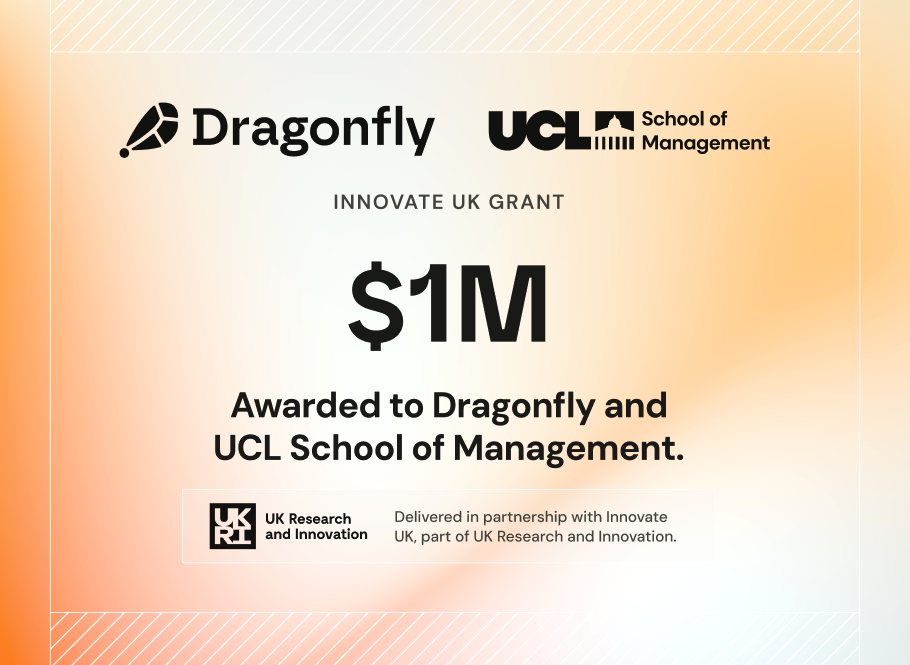
Today we get to share some news we've been sitting on for a while. Dragonfly, in partnership with UCL School of Management, has been awarded £704,863 (approximately $1 million) in funding from Innovate UK, part of UK Research and Innovation (UKRI), through the Secure Software for Resilient Growth competition. The 18-month project starts this month, and it takes aim at one of the hardest problems in technology decision making: how do you know whether the software running your business can actually be trusted, together, as a whole?
The question that kept coming up
When we started Dragonfly in December 2024, the bet was simple. Choosing software is broken, and the businesses living with the consequences of those decisions deserve independent, honest answers they can act on. So we built a knowledge graph of more than 300,000 software vendors and launched publicly last October, backed by a £2.6M pre-seed led by Episode 1 alongside Portfolio Ventures and Dreamcraft.
Since then we've spoken with hundreds of businesses about their stacks, and almost every serious conversation lands on the same question of trust. That question goes far beyond any single vendor. Leaders want to know whether the tools they've chosen can safely and effectively work together, especially now that AI systems and autonomous agents are being wired into stacks faster than anyone can evaluate them.
The uncomfortable truth is that existing security tools can't answer that question. They assess vendors one at a time, but real-world risk lives in the connections between tools. The data flows, the integrations, the shadow IT, the over-privileged connectors that quietly link everything together. A business can select ten individually "secure" products and still end up with a dangerously insecure whole.
That's not a theoretical problem. Cyber attacks cost the UK economy an estimated £14.7 billion a year, roughly 0.5% of GDP, and fragmented, poorly secured software infrastructure is among the weaknesses attackers exploit most.
A standard exists. Almost nobody can use it.
In January 2025, the UK Government published the Software Security Code of Practice (SSCoP): 14 principles that set a baseline for software security across supply chains. It's a genuinely useful piece of work. It's also, for most businesses, a document rather than a tool. Very few organisations have the expertise to check whether their stack meets the standard, or to make security-informed decisions when choosing what to buy next.
That gap, between a published standard and a business's ability to actually apply it, is exactly the kind of problem Dragonfly exists to close.
What we're building with UCL
Over the next 18 months, we'll build a secure stack advisory layer on top of Dragonfly's knowledge graph. Concretely, that means:
- Encoding all 14 SSCoP principles as machine-queryable attributes, cross-mapped to the standards businesses are already accountable to: ISO 27001, NIS2 and the EU Cyber Resilience Act.
- A compositional risk engine that evaluates complete multi-vendor stacks rather than individual tools: tracing data flows across tool boundaries, detecting weakest links and shadow IT exposure.
- Plain-language, citation-backed recommendations that a non-technical decision maker can read, trust and act on.
The result is the world's first machine-queryable trust layer for software. Ask it whether your stack meets the SSCoP baseline and you get an answer with evidence behind it, in seconds. And because it's machine-queryable, it's not only humans who can ask. As businesses hand more decisions to AI agents, those agents need a trustworthy source to check against before they act. We're building the layer they'll check.
Why UCL
Evaluating a technology stack is a brutally hard combinatorial problem. Hundreds of tools, each with its own security posture, assessed against interoperability, regulatory and security constraints that all interact with each other. This is decision-making under uncertainty at serious scale, and it's precisely the territory of our partners at UCL School of Management.
The research will be led at UCL by Professor Onesun Steve Yoo as Principal Investigator, alongside co-investigators Dr Yi-Chun Akchen, Dr Yuri Resende Fonseca and Dr Aras Selvi. Between them, the team brings deep expertise in optimisation, machine learning and decision-making under uncertainty. Pairing that rigour with the real-world data in our knowledge graph, and the real-world questions our customers ask every day, is what makes this project possible at all.
What this means for Dragonfly
We're entering a world where every business will have both human and AI colleagues working side by side. The technology decisions organisations make over the next decade will shape their ability to innovate, compete and adopt AI safely. Our vision has always been to build the world's most trusted intelligence layer for those decisions, and this project moves trust from something we describe to something you can query.
The support from Innovate UK is a serious validation of both the problem and the opportunity, and it means this research happens here in the UK, contributing to the UK's leadership position in secure software and AI innovation.
A huge thank you to the team at Innovate UK, and to Steve, Yi-Chun, Yuri and Aras at UCL. We can't wait to get started. Well, technically, we already have.
You can read the full press release here, and if you'd like to see what Dragonfly can already tell you about your stack, visit askdragonfly.com.
Blog
August 17, 2026
0
min read
The People Pillar
AI doesn't replace your team. It rewrites their job description.
Sean King
CoFounder of Dragonfly
August 17, 2026
0
min read
Sean King
CoFounder of Dragonfly
The People Pillar
Here is a test worth running on your own company. Find the team that has taken to AI most enthusiastically: the highest usage, the stickiest tools, the greenest dashboard. Now picture switching all of it off tomorrow. Would their work actually change? Or would they be a little slower for a week, and then carry on exactly as they did before?
For most companies, the honest answer is the second one. And it is the single most important thing leadership doesn't yet know about its own AI rollout.
That gap, between a tool that gets used and a business that genuinely changes, is what this paper is about. Because the uncomfortable truth sitting underneath every green dashboard is this: usage is not adoption. People can open a chatbot every day, hit every prompt quota and rate the tool nine out of ten, and still do their jobs the exact way they did two years ago. Activity is easy to count. Change is the thing that matters, and it barely registers on any dashboard a vendor will sell you.
What follows is the shape of that argument. The paper is where it becomes a diagnostic tool: a way to see where each team really stands, tell real change from activity that just looks busy, and find the next move that turns AI from something your people use into the way they work.
Inside the People paper, a first look
Most people will read the title and assume this is a paper about training, communities of practice and change management. It isn't.
The reframe at the centre of it is simple. Your people are not the audience for AI. They are the operating system it runs on. Every workflow you have is implemented through human beings: their judgement, their relationships, the institutional knowledge held in their heads, the incentives they respond to, the rituals they have built around the work. AI does not sit politely on top of that layer. It rewires it.
Which is why training rarely moves the needle. You can teach prompting all day. But if nobody has told a person what their job becomes once a model can do the part they were hired for, you haven't answered the only question they are actually asking:
The three stances: Permitted, Embedded, Reconfigured
Across the companies we've mapped, that rewiring lands in one of three places. We call them stances, because a stance is something you can observe rather than something you can claim. Each one is defined by what has structurally changed in how the work gets done, not by what was said at the all-hands. And it is almost always a step behind where leadership believes the company sits.
- Permitted. AI is allowed, and almost nothing else has changed. The tools are in, a policy exists, a handful of power users are doing real work. But the org chart, the targets and the rituals are untouched. This is where most companies are today, and it hides comfortably behind a busy usage dashboard.
- Embedded. The practice has changed, even if the job description hasn't caught up. Teams share prompts and Skills, build AI into how they review and decide, and managers can name their power users. It is a transitional state. Companies either lock it in or slide back the moment the early believers move on.
- Reconfigured. The job itself has been rewritten around what AI cannot do: judgement under uncertainty, relationships, accountability, taste, the hard edge cases. Roles, targets, hiring and career paths all assume AI is a teammate, not a tool. Very few organisations are here yet.
The quickest tell: ask someone to describe their job today, then to describe it two years ago. At Reconfigured, the two answers sound like different jobs. At Permitted, they are the same job with "and I use AI sometimes" added to the end.
The trap: a flat dashboard looks like resistance
When adoption stalls, the easy story is that people are dragging their feet. They are not. What looks like resistance is almost always a rational response to a question the organisation has left unanswered.
Think about what AI does to a role. It absorbs the very work a person was hired for, promoted on and measured against. Leave their targets and incentives pointing at that same work, now that a model does it in seconds, and you have quietly asked them to make themselves redundant on paper while still hitting the old numbers. No training session resolves that. A flat dashboard isn't your people refusing to change. It is the organisation changing what its tools can do without changing what it asks of, or rewards in, the people using them.
What looks like resistance is almost always a rational response to a question no one has answered.
What's in the full paper
Everything above is the argument in outline. The paper is where it turns operational. Inside, you'll find:
- The three forces that keep the dashboard flat, identity, incentives and leadership, and why each one survives every training programme you throw at it.
- Worked examples from Finance and Operations, following real roles across all three stances, down to how a single job title can describe two completely different jobs.
- A way to measure change instead of activity. Licences, prompts and self-reported "hours saved" look the same whether AI is transforming the business or sitting idle. The paper sets out the questions that tell the two apart, at the level of the business, the team and the individual.
- Why culture is the precondition the rest of it depends on, and the one call leadership cannot delegate to anyone else.
- How Dragonfly reads the stance and the friction beneath the usage: which teams have genuinely changed how they work, where everyday practice and company policy are pulling apart, and where the people driving your progress are being backed or quietly lost.
Read the summary and you'll have a sharper way of talking about AI. Read the paper and you'll have a sharper way of running the business.
The companies that reach Reconfigured won't be the ones with the biggest AI budgets. They'll be the ones that built the new way of working into how work actually gets done, rewrote the roles before the market forced their hand, and backed the right people while they still had them.
Where this sits: the three pillars
This is the second of three. Dragonfly's AI Readiness Framework stands on three pillars, and they only pay off together. Technology asks whether your tools are actually doing the work, or whether your people are quietly holding them together. People, this paper, asks what happens once those tools are in. Strategy, still to come, is where the two get aligned: where to point AI, what it should be solving, and which trade-offs to make as the ground keeps shifting from one week to the next.
They're built to be read together. If you haven't yet, start with the Technology pillar, the ground everything here is built on. Read all three and you see the whole machine, not a single gear of it.
Blog
August 17, 2026
0
min read
The Technology Pillar
Most companies don't have an AI stack. They have AI features bolted onto yesterday's processes.
Sean King
CoFounder of Dragonfly
August 17, 2026
0
min read
Sean King
CoFounder of Dragonfly
The Technology Pillar
Everyone is talking about AI. Copilots, agents, autonomous workflows. But when we sit down with the founders, CTOs and ops leaders actually running fast-scaling companies, the reality looks nothing like the LinkedIn posts.
People in over 90 percent of companies are using AI tools at work today. The trouble is that almost none of those companies can answer the only question that actually matters: where exactly is my business today, and what's the next move?
That's the job of the Dragonfly AI Readiness Framework. It evaluates a business not by how many tools it owns, but by how much human effort is still required to move work from one step to the next inside its core processes. Across that mapping work, in sales, support, engineering, HR, finance and marketing, one pattern repeats: most scaling companies are stuck somewhere between digitised and automated, nowhere near ready to unlock what AI can actually do for them.
Three pillars, one honest diagnostic
The framework looks at readiness through three pillars.
Technology asks whether the tools at each stage of your core processes are actually doing the work, or whether your team is silently filling the gaps between them with copy-paste, side spreadsheets and end-of-day catch-ups.
People is about what happens after the tools are in. If you've shipped AI to your team and watched most of them drift back to their old workflows within weeks, the People pillar explains why that isn't an adoption problem at all, and what has to shift underneath for any of the tools to actually stick.
Strategy is what holds the other two together. If your AI strategy was greeted with applause at the offsite but you can't name a single thing it has changed in the business since, the Strategy pillar lays out the decisions any real strategy has to commit to, the ones most leadership teams quietly skip.
Inside the Technology paper, a first look
This summary covers paper one of three, the Technology pillar. It comes first for a reason. People won't adopt tools that don't fit how their work actually flows, and no strategy can compensate for a stack that's quietly held together by human effort. Before you can change the work, you have to see it clearly. That's what the Technology pillar is for.
Within Technology, every core process in your business sits at one of five readiness levels. These aren't marketing tiers. They represent a fundamental evolution in what you're asking your software to do, and they determine the ceiling of what AI can deliver for you.
- Level 1, Analog. Whiteboards, spreadsheets, and people remembering things in their heads.
- Level 2, Digitised. Systems of record. CRMs, ERPs and helpdesks that store information but don't move it.
- Level 3, Operational. Rules and macros stitching tools together. Efficient, but fragile.
- Level 4, Augmented. Software that thinks with your team. Predictive insights, copilots, context-aware workflows.
- Level 5, Autonomous. Software that runs end to end. You set the outcome, the system does the work, and only loops in humans when judgement is actually required.
AI adds value at every level. But the magnitude compounds as you climb. A company stuck at Level 2 is leaving most of AI's potential on the table, not because they lack ambition, but because their infrastructure can't support it.
The trap: everyone thinks they're at Level 4
Almost every leadership team we sit with believes they're already operating at an advanced level. They have a CRM. They have dashboards. They've rolled out a copilot, maybe experimented with agents. So they assume they're AI-ready.
But when we map the real flow of work, the picture changes fast. Data is still being copied between systems by hand. Decisions still live in people's heads. Automation exists, but it's brittle. A patchwork of if/then rules duct-taped across tools that were never designed to work together.
That's Level 2 and Level 3 behaviour wearing a Level 4 badge. It's also exactly where most AI projects quietly fail.
AI doesn't fix broken processes. It exposes them.
Layering intelligence on top of fragmentation doesn't transform anything. It just makes the cracks faster and more visible. The real work isn't choosing better AI. It's seeing your processes clearly enough to know which ones can actually carry intelligence, which ones need to be redesigned first, and which ones are being held together by nothing but human patience.
That diagnostic, applied to your business, is what the rest of the Technology paper delivers.
What's in the full paper
What you've just read is the framework in outline. It's the part that fits in a website summary. The paper itself is where the framework becomes a tool you can actually use, and that's the part that changes how you spend the next twelve months. The summary makes the case. The paper makes the difference. Inside, you'll find:
- The full anatomy of each of the five levels: what AI can and can't realistically do at each, why the ROI equation flips between Level 3 and Level 4, and where most companies actually sit, which is rarely where they think they sit.
- The decision framework for when Level 5 is the right call and when chasing it is a mistake. Moving every process to autonomy isn't the goal, and treating it as one is as misguided as buying tools without a strategy.
- Worked examples for outbound sales and customer support, mapping the exact stages, tools and metrics that shift as you climb the framework.
- How Dragonfly's AI Readiness Platform turns the framework into a live benchmark of your specific stack against the best alternatives in the market, so you stop guessing and start comparing.
If you stop reading at the summary, you'll have a sharper way of talking about AI readiness. If you read the paper, you'll have a sharper way of running the business.
The next generation of companies won't win by owning more software. They'll win by evolving faster than their market, and that journey starts with brutal clarity about how your business actually runs today.
Download the full paper to see where yours stands.
News
August 17, 2026
0
min read
Dragonfly raises £2.6 million pre-seed to help businesses get ahead with smarter decisions about software
Dragonfly, the world’s most powerful software discovery platform, today announced the close of a £2.6M pre-seed round alongside the public launch of its conversational AI tool. Founded in December 2024 by Zego alumni Sean King and Sven Sabas, the round was led by Episode 1, joined by Dreamcraft and Portfolio Ventures, with angels including QuantumBlack founder and CTO Sam Bourton, and Bolt founder and CEO Markus Villig.
Sean King & Sven Sabas
Dragonfly Founders
August 17, 2026
0
min read

Sean King & Sven Sabas
Dragonfly Founders
Dragonfly raises £2.6 million pre-seed to help businesses get ahead with smarter decisions about software
The number of software tools has exploded in recent years. Tech users no longer find themselves facing a decision between an incumbent provider and a challenger; today, there may be hundreds of options to consider for any given job. The rise of AI and vibe-coding has rapidly accelerated the development of new applications, but substantially increased the time needed to evaluate the security, reliability and interoperability of different technologies. Expert advice on business architecture - from systems architects or management consultants - is inaccessible to the majority due to high costs, and the pace of innovation makes it impossible for anyone to stay up-to-date.
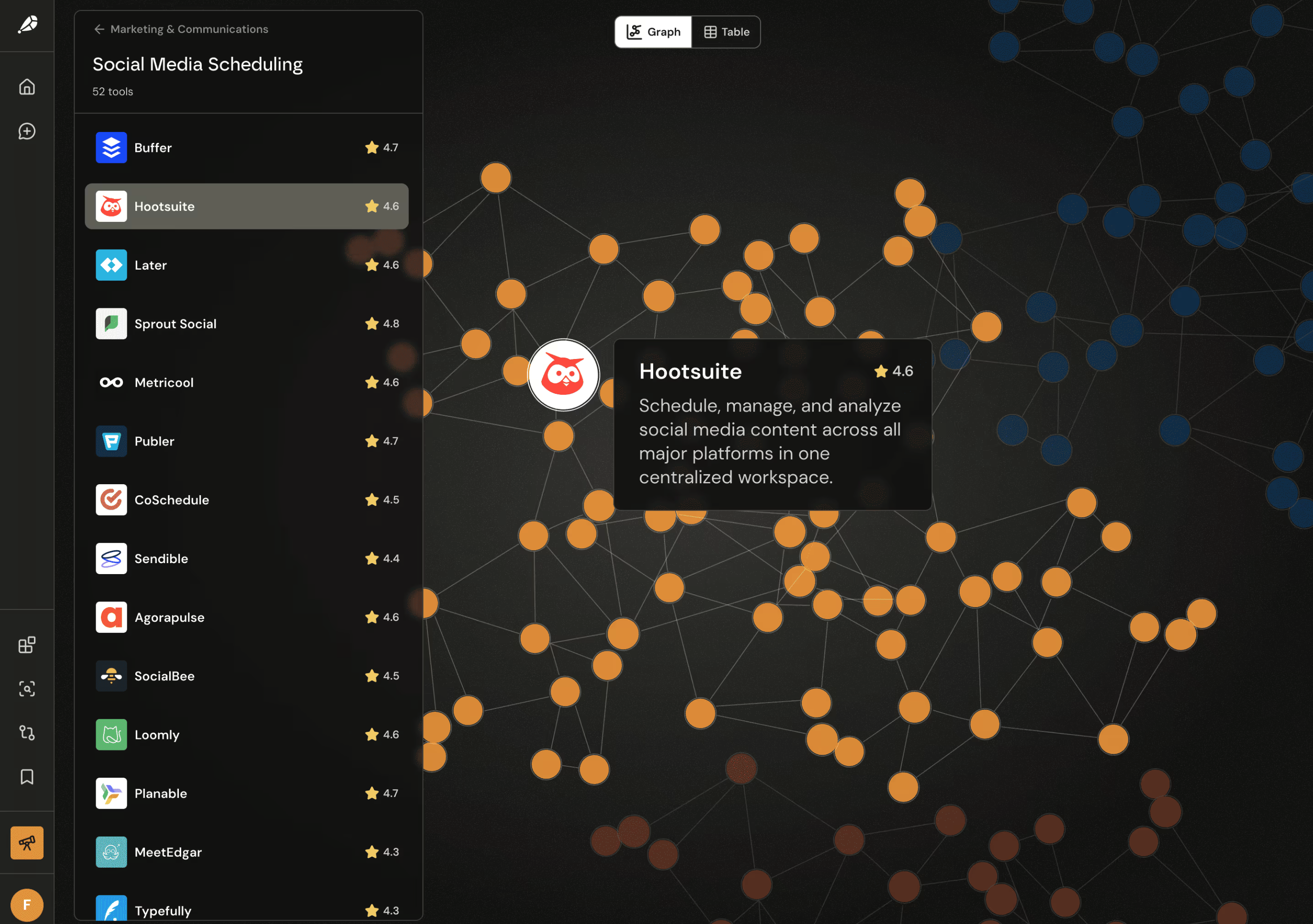
Dragonfly aims to make the expertise of a solutions architect instantly accessible to everyone, from individual professionals to enterprise leaders. The startup has compiled the world’s largest catalogue of software tools and their capabilities, currently standing at over 250,000 products, from a range of trusted data sources. This dataset feeds into a variety of AI-powered features, which will help users find the right tech stacks in seconds, rather than months.
Today, Dragonfly has made its proprietary conversational AI tool available to the public. Instead of scrolling through marketplaces filled with outdated and incomplete information, or sitting through lengthy sales demos, users will be able to ask Dragonfly questions; within seconds, Dragonfly will recommend a list of suitable products, ranked by relevance, with supporting explanations.
The tool is designed to cater for simple queries in plain language, such as "what’s the best project management software for a team of five that integrates with Google Calendar and has a free plan," and more complex prompts, for example "we need to build a secure, compliant technology architecture to support a new financial services product for our European customers; we need recommendations for tools that can handle real-time data ingestion, are GDPR-compliant, and integrate with our existing AWS infrastructure, and we'd also like to see how these tools would work together in a single blueprint.
From late 2025, Dragonfly is set to roll out its enterprise offering to help organisations build, manage and evolve their tech stacks. Businesses will be able to map out their software with the aid of Dragonfly’s ‘digital fingerprinting’ technology, which captures a blueprint of their business system architecture. With this detailed context, Dragonfly will supply insights and software recommendations tailored to each company’s environment, goals and growth stage.
King and Sabas have assembled a team of 12 with several former colleagues from Zego, Peppy and Permutive joining the founders in their new venture. The pre-seed funds will be used to develop a range of new features in support of the startup’s mission to build a comprehensive ‘Automated Solutions Architect’, further enrich Dragonfly’s data, and recruit select new hires as needed.
Hector Mason, General Partner at Episode 1, said: "Before Dragonfly, it was almost impossible to gather enough context about software tools to truly understand their capabilities, and whether they fit seamlessly within an existing stack. By solving this critical problem, made even more urgent with the rapid adoption of AI, Dragonfly has the potential to make every company on the planet operate more effectively.
Sam Bourton, co-founder and CTO at QuantumBlack, said: “I first met Sean and Sven after having spent three days with 150 CIOs and CTOs, witnessing firsthand the mounting complexity of the modern tech and data landscape. The explosion of GenAI and agentic systems has amplified the problem - leaders face a firehose of requests for new AI tools, with a thousand flowers blooming across their organisations, each demanding attention and resources. Taking stock of their existing tech stack, evaluating options, and managing security, dependencies, and integrations has never been harder.
To try Dragonfly for free, visit www.askdragonfly.com or see our social media channels for latest updates.
Subscribe to our newsletter
Catch the latest trends and insights straight in your inbox.
We’re happy to have you with us