
The People Pillar
17 August 2026
AI doesn't replace your team. It rewrites their job description.
Here is a test worth running on your own company. Find the team that has taken to AI most enthusiastically: the highest usage, the stickiest tools, the greenest dashboard. Now picture switching all of it off tomorrow. Would their work actually change? Or would they be a little slower for a week, and then carry on exactly as they did before?
Usage is not adoption. Take AI away tomorrow, and would the work actually change, or would people just be slower for a week?
For most companies, the honest answer is the second one. And it is the single most important thing leadership doesn't yet know about its own AI rollout.
That gap, between a tool that gets used and a business that genuinely changes, is what this paper is about. Because the uncomfortable truth sitting underneath every green dashboard is this: usage is not adoption. People can open a chatbot every day, hit every prompt quota and rate the tool nine out of ten, and still do their jobs the exact way they did two years ago. Activity is easy to count. Change is the thing that matters, and it barely registers on any dashboard a vendor will sell you.
What follows is the shape of that argument. The paper is where it becomes a diagnostic tool: a way to see where each team really stands, tell real change from activity that just looks busy, and find the next move that turns AI from something your people use into the way they work.
Inside the People paper, a first look
Most people will read the title and assume this is a paper about training, communities of practice and change management. It isn't.
The reframe at the centre of it is simple. Your people are not the audience for AI. They are the operating system it runs on. Every workflow you have is implemented through human beings: their judgement, their relationships, the institutional knowledge held in their heads, the incentives they respond to, the rituals they have built around the work. AI does not sit politely on top of that layer. It rewires it.
Which is why training rarely moves the needle. You can teach prompting all day. But if nobody has told a person what their job becomes once a model can do the part they were hired for, you haven't answered the only question they are actually asking:
What does my job become on the other side of this?
The three stances: Permitted, Embedded, Reconfigured
Across the companies we've mapped, that rewiring lands in one of three places. We call them stances, because a stance is something you can observe rather than something you can claim. Each one is defined by what has structurally changed in how the work gets done, not by what was said at the all-hands. And it is almost always a step behind where leadership believes the company sits.
- Permitted. AI is allowed, and almost nothing else has changed. The tools are in, a policy exists, a handful of power users are doing real work. But the org chart, the targets and the rituals are untouched. This is where most companies are today, and it hides comfortably behind a busy usage dashboard.
- Embedded. The practice has changed, even if the job description hasn't caught up. Teams share prompts and Skills, build AI into how they review and decide, and managers can name their power users. It is a transitional state. Companies either lock it in or slide back the moment the early believers move on.
- Reconfigured. The job itself has been rewritten around what AI cannot do: judgement under uncertainty, relationships, accountability, taste, the hard edge cases. Roles, targets, hiring and career paths all assume AI is a teammate, not a tool. Very few organisations are here yet.
The quickest tell: ask someone to describe their job today, then to describe it two years ago. At Reconfigured, the two answers sound like different jobs. At Permitted, they are the same job with "and I use AI sometimes" added to the end.
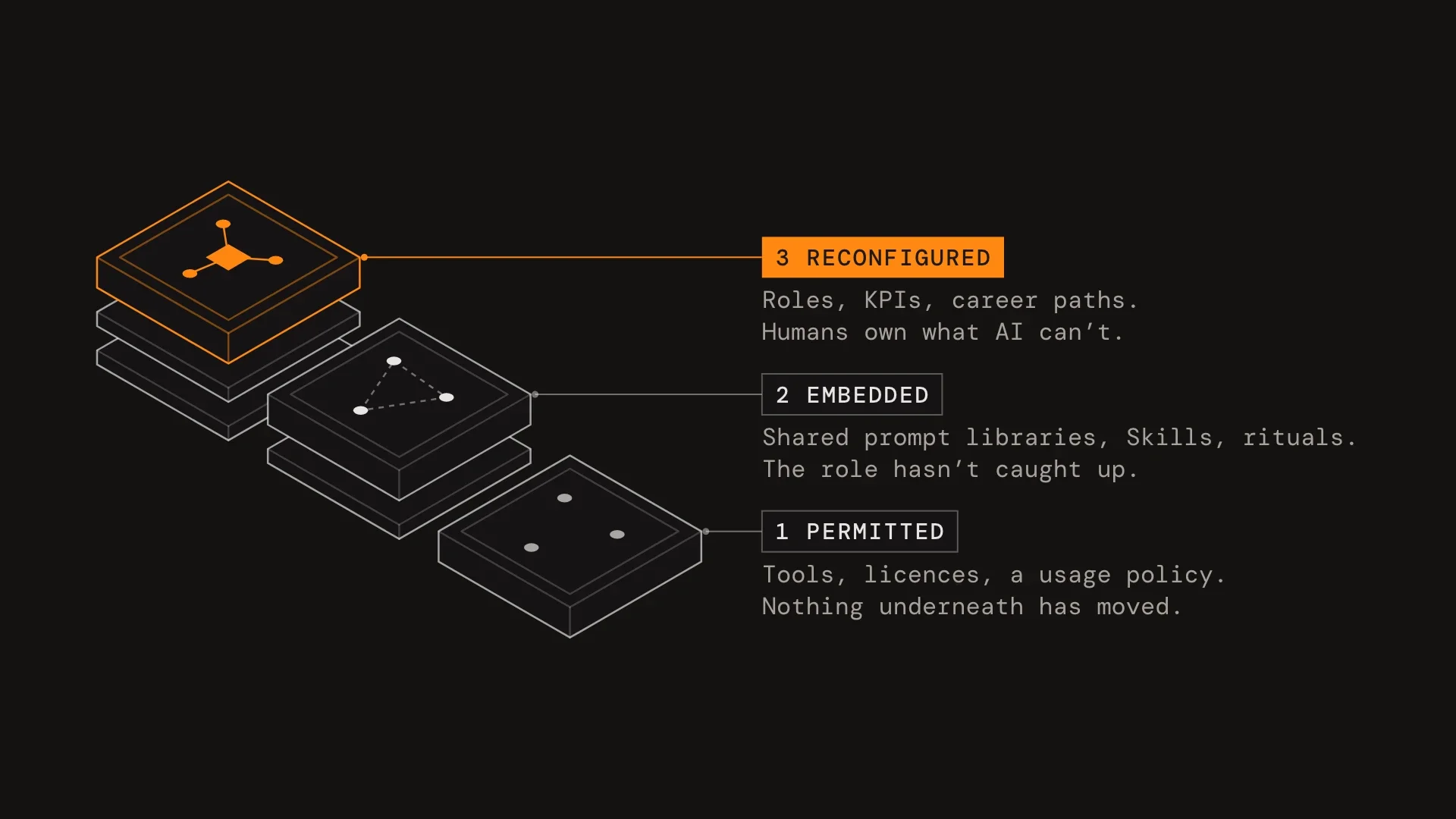
The three stances. Each one adds a layer of change to how the work is done.
The trap: a flat dashboard looks like resistance
When adoption stalls, the easy story is that people are dragging their feet. They are not. What looks like resistance is almost always a rational response to a question the organisation has left unanswered.
Think about what AI does to a role. It absorbs the very work a person was hired for, promoted on and measured against. Leave their targets and incentives pointing at that same work, now that a model does it in seconds, and you have quietly asked them to make themselves redundant on paper while still hitting the old numbers. No training session resolves that. A flat dashboard isn't your people refusing to change. It is the organisation changing what its tools can do without changing what it asks of, or rewards in, the people using them.
What looks like resistance is almost always a rational response to a question no one has answered.
What's in the full paper
Everything above is the argument in outline. The paper is where it turns operational. Inside, you'll find:
- The three forces that keep the dashboard flat, identity, incentives and leadership, and why each one survives every training programme you throw at it.
- Worked examples from Finance and Operations, following real roles across all three stances, down to how a single job title can describe two completely different jobs.
- A way to measure change instead of activity. Licences, prompts and self-reported "hours saved" look the same whether AI is transforming the business or sitting idle. The paper sets out the questions that tell the two apart, at the level of the business, the team and the individual.
- Why culture is the precondition the rest of it depends on, and the one call leadership cannot delegate to anyone else.
- How Dragonfly reads the stance and the friction beneath the usage: which teams have genuinely changed how they work, where everyday practice and company policy are pulling apart, and where the people driving your progress are being backed or quietly lost.
Read the summary and you'll have a sharper way of talking about AI. Read the paper and you'll have a sharper way of running the business.
The companies that reach Reconfigured won't be the ones with the biggest AI budgets. They'll be the ones that built the new way of working into how work actually gets done, rewrote the roles before the market forced their hand, and backed the right people while they still had them.
Where this sits: the three pillars
This is the second of three. Dragonfly's AI Readiness Framework stands on three pillars, and they only pay off together. Technology asks whether your tools are actually doing the work, or whether your people are quietly holding them together. People, this paper, asks what happens once those tools are in. Strategy, still to come, is where the two get aligned: where to point AI, what it should be solving, and which trade-offs to make as the ground keeps shifting from one week to the next.
They're built to be read together. If you haven't yet, start with the Technology pillar, the ground everything here is built on. Read all three and you see the whole machine, not a single gear of it.
Dragonfly News
Subscribe to our newsletter.
Catch the latest trends and insights straight in your inbox.
Related posts
Press release
Modern Data Stack joins Dragonfly
Dragonfly has acquired Modern Data Stack, the community and directory of more than 500 data tools.
2 September 2026
Awards
From 1,600 startups to the Onstage stage
Dragonfly was one of the startups chosen from more than 1,600 applicants to pitch live at Onstage S26 in London, in front of more than 100 investors and senior leaders.
26 August 2026

Awards
Ten 'secure' tools can still make one insecure stack. Dragonfly and UCL just won Innovate UK funding to fix that
18 months, $1m, and one goal: turning the UK's Software Security Code of Practice into something businesses can actually use
17 August 2026
See how Dragonfly can work for you.
A short call shows you how all of this looks with your tech stack.
Book a demo